

You’re not imagining it – creatine is everywhere right now. Search interest has more than doubled since 2023, and the global market is projected to exceed US$2.6 billion by 2030. This rise in popularity isn’t just about gym gains – it’s being driven by growing evidence linking creatine to brain function, mood, hormonal balance, bone strength, and fatigue recovery.
From strength athletes to longevity seekers, people are realising that creatine isn’t just for gym performance – it’s a science-backed tool for neuroprotection, hormonal resilience, and healthy ageing. And here’s something surprising: research suggests women may actually stand to gain more from creatine than men, thanks to key physiological differences and unique demands across the female lifespan.
In this article, we’ll break down how creatine works, who benefits most, and why this once gym-exclusive supplement is becoming a cornerstone of health optimisation.
What is creatine, and how does it work?
Creatine is a naturally occurring compound made from three amino acids – arginine, glycine, and methionine – and stored primarily in your muscles and brain. In its active form, phosphocreatine, it acts as your body’s rapid energy buffer, recycling ADP (adenosine diphosphate – a used-up energy molecule) back into ATP (adenosine triphosphate – your cellular fuel) during periods of high demand.
This quick recycling of energy makes creatine essential not just for explosive exercise like sprinting or lifting, but also for:
- Mentally demanding tasks
- Hormonal shifts (like perimenopause or menstrual phases)
- Immune stress and recovery
- Ageing-related energy decline
Creatine is naturally present in animal products like meat and fish, but often in amounts too low to fully saturate the body’s stores, especially if:
- You eat a plant-based or low-protein diet
- You have lower muscle mass
- You’re navigating life stages that affect synthesis, such as pregnancy, perimenopause, or menopause
“You only get about 1 gram from diet, and if you’re plant-based, you’re probably getting close to zero.”
– Dr Darren Candow
By contrast, the typical supplemental dose used to support full-body creatine saturation is around 3–5 grams per day. When protein intake or synthesis is low, supplementing helps restore levels needed for optimal energy production, recovery, and cellular resilience.
So if you’re dealing with brain fog, hormonal shifts, low energy, or slow recovery, creatine may be one of the simplest ways to upgrade your cellular energy and overall vitality.
Let’s explore how creatine delivers benefits far beyond muscle – with science-backed effects on the brain, bones, hormones, and beyond.
Health benefits of creatine
The expanding evidence for creatine is changing the way we think about its use, not just for performance, but as a multi-system biohack that supports brain, bone, and cellular resilience.
Let’s look at how creatine translates that into real-world benefits across multiple systems.
Creatine for physical performance and muscle preservation
Creatine is one of the most effective supplements for people who train regularly, whether you’re lifting weights, sprinting, or doing high-intensity workouts. Here’s how it can support your performance and recovery:
- Increases strength and power output
- Improves muscle recovery
- Enhances muscle growth
- Delays fatigue during workouts
- Boosts performance in repeated bouts of effort
- Supports brain function under physical stress
- May aid thermoregulation and hydration
Described by creatine researcher Dr Darren Candow as “the safest, most effective ergogenic aid available right now,” creatine is increasingly recognised as a foundational supplement for enhancing performance, recovery, and long-term resilience – especially when paired with resistance training.
It’s not just about short-term gains, either. Creatine also supports muscle preservation as we age, helping to reduce the risk of sarcopenia (loss of muscle mass), falls, frailty, and biological ageing.
A 2019 review co-authored by Dr Darren Candow in the Journal of Clinical Medicine found that creatine supplementation, especially when paired with resistance training, not only increases lean muscle mass but also reduces inflammation and fall risk in older adults.
And it’s not just your muscles that benefit – your brain does, too.
Creatine for brain health and cognition
While creatine is widely known for its physical benefits, growing research shows it also plays a key role in supporting brain function, particularly under stress.
“Think of creatine as an energy reservoir for your brain.”
– Dr Darren Candow
Creatine helps fuel brain cells by enhancing mitochondrial energy metabolism and buffering against oxidative stress, neuroinflammation, and neurotransmitter imbalances.
Dr Rhonda Patrick, PhD, a biomedical scientist specialising in brain metabolism and healthspan, and founder of FoundMyFitness, highlights that during periods of elevated cognitive stress, the brain burns through its creatine stores more rapidly. Supplementing with creatine can help maintain mental performance by supporting the brain’s energy systems, enhancing cognitive function, and boosting resilience – especially under sleep deprivation or prolonged demand.
There’s also increasing interest in creatine’s potential to reduce neuroinflammation, which may partly explain its neuroprotective and mood-stabilising effects. This becomes particularly relevant during ageing, sleep disruption, or recovery from brain injury.
A 2024 Nature study, highlighted by Dr Patrick, found that a single high dose of creatine monohydrate (around 20–30 g, depending on body weight) significantly improved cognitive performance after 21 hours of sleep deprivation. Brain scans revealed key changes: elevated phosphocreatine and ATP levels, improved brain energy balance, and faster processing speed. These findings highlight creatine’s role as a brain energy buffer – not just during everyday mental tasks, but in protecting cognition under extreme stress.
Emerging evidence shows creatine may:
- Improve short-term memory and processing speed
- Reduce mental fatigue during cognitively demanding tasks
- Offer neuroprotection under stress (e.g. sleep loss, ageing, injury)
- Support mood regulation, with potential benefits in depression and stress-related mood changes
But creatine’s support for healthy ageing doesn’t end with the brain – it also plays a role in protecting the structure and strength of your bones.
Creatine for bone strength and geometry
Creatine isn’t a standalone bone builder, but when combined with resistance training, it plays a supportive role in improving bone structure and reducing fracture risk.
Rather than significantly increasing bone mineral density (BMD), creatine has been shown to enhance bone geometry, including femoral neck thickness and cortical density – two key factors in bone strength and resilience. These structural improvements may help lower the risk of fractures, particularly in older adults or those with declining bone integrity.
Why women may benefit even more than men
The opportunity for women may be greater than men, due to both physiological differences and higher likelihood of deficiency. Women typically have lower baseline creatine stores than men, and life stages like menstruation, pregnancy, perimenopause, and menopause can further impact creatine synthesis and use. This makes supplementation a compelling option for women across the lifespan.
Creatine may help:
- Stabilise mood and cognition during hormonal transitions
- Support muscle tone and bone strength post-menopause
- Enhance training response, even at lower doses
A 2021 review highlighted creatine’s unique value during perimenopause and menopause, not just for supporting physical recovery, but also for improving cognitive function and mood stability. More recent findings have broadened its potential applications, suggesting creatine may also:
- Reduce fatigue-related symptoms linked to the menstrual cycle
- Support vegans and vegetarians with lower baseline creatine levels
- Assist women with clinical conditions like muscle wasting, neurodegeneration, cardiovascular compromise, or chronic fatigue
How to take creatine
Creatine dosing can be tailored to your goals – whether that’s building muscle, supporting cognition, or promoting healthy ageing. Creatine monohydrate remains the most studied and cost-effective form, with micronised versions often better tolerated by the gut.
When starting creatine, the typical approach is to begin with a loading dose – a higher amount taken for about 5–7 days to quickly saturate the body’s cells – followed by a maintenance dose to keep levels steady over time.
Here’s how to match your dose to your needs:
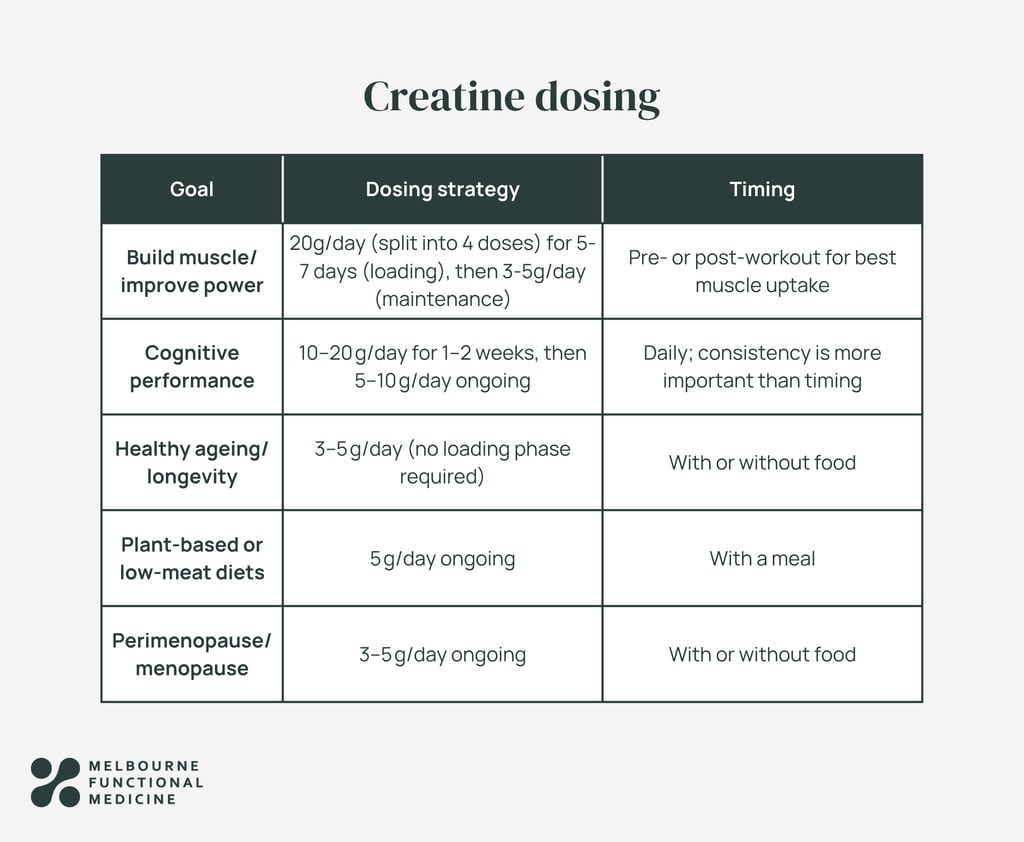
With regards to the loading dose, most people actually just take a single daily dose of 20g rather than dividing into 4 doses, but it can cause diarrhoea in some people, as creatine attracts water. In this case, it is suggested to reduce the dose to tolerable levels, or just take 5-7g/day consumed slowly over the course of the day (i.e. from a water bottle throughout the day) which should reduce bowel symptoms.
For best results, make sure to stay well-hydrated – creatine works by drawing water into your cells, so adequate fluid intake supports its effectiveness. If you’re aiming for cognitive benefits, keep in mind that brain saturation takes longer than muscle saturation, and you may need a higher dose or a longer loading phase to see results.
Is creatine safe? What you need to know
Short answer: Yes – for most people. Creatine is one of the most extensively studied supplements, with hundreds of human trials confirming its safety across diverse populations, from athletes to older adults.
That said, there are a few situations where caution is advised due to limited or inconclusive research. Creatine is generally safe, but use caution or consult your practitioner if you:
- Have kidney disease
- Have liver disease
- Live with certain psychiatric conditions
- Have diabetes
Creatine also shows promise in supporting pregnancy and breastfeeding outcomes, but current data is still emerging. Until more is known, it’s best to approach these life stages with extra care.
As always, check with your healthcare provider to make sure creatine is right for you, especially if you have any underlying health conditions.
Should you take creatine? A functional medicine perspective
In functional medicine, we prioritise low-risk, high-reward interventions that support multiple systems at once, and creatine fits that model perfectly.
It enhances mitochondrial function, preserves muscle and bone mass, supports brain health, and shows particular benefit for women and older adults. It’s safe, widely accessible, cost-effective, and backed by decades of research.
Whether your goal is to lift heavier, think sharper, age slower – or all of the above – creatine could be one of the smartest additions to your daily routine.
Curious whether creatine is right for your unique goals, or how to combine it with other health optimisation strategies?
Book a discovery call with our team at Melbourne Functional Medicine and take the next step toward a more resilient, energised you.