


It’s home to hundreds of microbial species, shaping your nitric oxide levels, immune signalling, inflammation, and even how well you recover after training. And yet, for most people, oral health still just means clean teeth and minty breath.
But that mindset is shifting.
From leading functional dentists like Dr Staci Whitman, Dr Mark Burhenne, and Dr Victoria Sampson to mainstream voices like Andrew Huberman, Gary Brecka, and Dhru Purohit, one message is gaining traction: the oral microbiome is a critical player in your systemic health.
What’s happening in your mouth could be fuelling inflammation, disrupting hormones, or accelerating cognitive decline, long before symptoms show up.
If it’s not on your radar yet, your oral microbiome might be the biggest blind spot in your optimisation strategy.
In this article, we’ll break down what the oral microbiome is, how it influences healthspan and performance, and why testing it could uncover leverage points you didn’t know you were missing.
What is the oral microbiome – and why are experts paying attention?
Your mouth is home to more than 700 species of bacteria, along with fungi, viruses, and other microbes. This thriving ecosystem, known as the oral microbiome, plays a pivotal role in your immune system, digestion, detoxification, and even brain health.
It’s not just about preventing cavities or bad breath. As Dr Staci Whitman, a leading functional and paediatric dentist, puts it:
“Oral health is whole-body health. The oral microbiome is connected to everything.”
These microbes influence your ability to produce nitric oxide, a molecule critical for blood flow, performance, and mitochondrial function. They shape your immune response, contribute to your gut health, and can even serve as an early warning system for chronic disease.
This ecological view of the mouth is also championed by Dr Gerry Curatola, biological dentist and author of The Mouth-Body Connection. He argues that oral health isn’t about sterilising the mouth, but restoring balance to a microbial ecosystem that influences the whole body.
A growing number of experts, including Dr Mark Burhenne and Dr Victoria Sampson, are calling for a radical shift in how we approach oral health. Rather than focusing solely on teeth and gums, they advocate for exploring the microbial dynamics driving systemic outcomes. Dr Lewis Ehrlich, a leading holistic dentist in Australia, extends this perspective further, linking oral health to breathing, performance, and long-term resilience.
And with new tools that let us map the oral microbiome with precision, that investigation has never been more accessible, or more relevant to those optimising for longevity.
The oral-systemic connection: what’s happening below the surface?
We’re long past the idea that the mouth is somehow separate from the rest of the body. What happens in the oral microbiome doesn’t stay in the mouth. It influences your immune function, gut integrity, brain health, and even your risk of chronic disease.
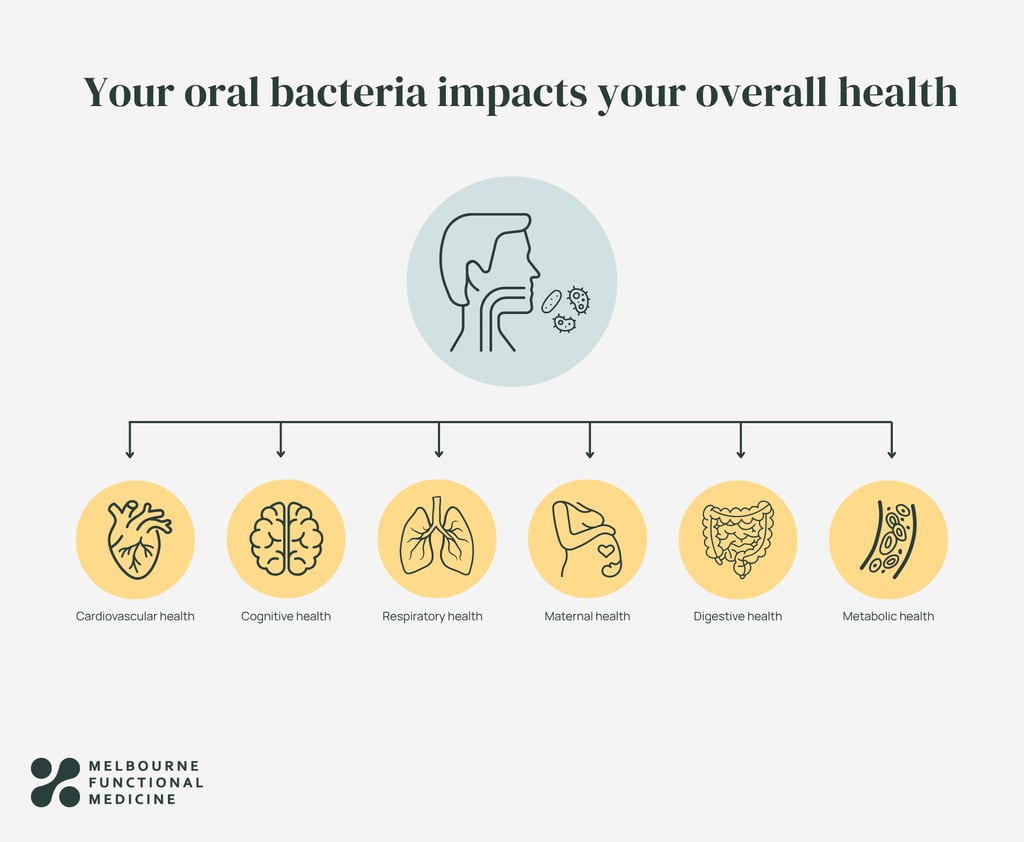
When oral dysbiosis occurs, an imbalance between beneficial microbes and harmful pathogens, it can silently fuel low-grade inflammation throughout the body. Pathogens like Porphyromonas gingivalis and Treponema denticola don’t just cause gum disease. They’ve been linked to:
- Cardiovascular disease: by contributing to arterial plaque formation
- Alzheimer’s disease: through their presence in brain tissue and inflammatory signalling
- Autoimmune conditions: by overstimulating the immune system
- Digestive issues: including leaky gut and SIBO (Small Intestinal Bacterial Overgrowth), by disrupting the upper GI microbial landscape
But the connection isn’t just one-way. The oral-gut axis functions as a two-way street. When oral dysbiosis goes unchecked, harmful bacteria can be swallowed and contribute to gut microbial imbalances, potentially triggering issues like SIBO or inflammatory bowel disease. Conversely, a disrupted gut microbiome may impair immune regulation in the mouth, creating a feedback loop that perpetuates inflammation on both ends of the digestive tract.
As Dr Victoria Sampson explains:
“Oral pathogens have been found in placental tissue, brain lesions, and joint fluid. The connection between the oral microbiome and systemic illness is no longer a theory – it’s observable in clinical research.”
The inflammatory cascade often begins years before symptoms appear. That’s why functional and biological dentists are urging a shift in perspective: the oral microbiome may be one of the earliest, and most modifiable, indicators of long-term health.
Your oral microbes don’t just sit passively; they help break down food, produce vitamins, and protect against pathogens. But under stress, this system can shift quickly. Low saliva production or high cortisol produced from chronic stress may reduce your oral defences and give pathogenic species the upper hand, further reinforcing the need to care for the oral microbiome as a dynamic, adaptive part of your body’s frontline defence.
Oral microbiome testing: A tool for longevity, performance and prevention
In the same way gut microbiome testing transformed how we approach digestion and immunity, oral microbiome testing is now reshaping how we view mouth-body health. Instead of guessing based on symptoms or dental history, you can now see exactly what microbes are living in your mouth and how they might be influencing your system.
As Dr Dominik Nischwitz (aka Dr. Dome) says:
“Test, don’t guess. When you know what’s colonising the mouth, you can create targeted, biological strategies that support the entire body.”
And it’s not just about oral hygiene. Many people are now using oral microbiome testing to optimise:
- Nitric oxide production: important for energy, exercise recovery, and vascular health
- Immune regulation: especially for those with allergies or autoimmunity
- Cognitive function: as part of strategies to reduce neuroinflammation
- Gut health: particularly in cases of reflux, bloating, or IBS
We are far beyond the paradigm that ‘all bugs are bad’; your oral microbiome is a garden to be nurtured, and treasured. The oral microbiome can contribute or detract from systemic health in a way that should not be ignored, and can only be explored through testing.
How we use oral microbiome testing at Melbourne Functional Medicine
At Melbourne Functional Medicine, we use the NutriPATH Oral Microbiome Mapping Test – clinical-grade pathology to explore microbial dynamics of your mouth with precision.
This test uses quantitative PCR (qPCR) technology to detect and measure a wide range of microbes, including:
- Pathogenic bacteria linked to gum disease and systemic inflammation (P. gingivalis, T. denticola, T. forsythia)
- Commensal bacteria that help protect against infection and maintain balance (Streptococcus salivarius, Lactobacillus species)
- Fungi, such as Candida albicans, which may contribute to oral thrush, gut dysbiosis, or immune disruption
- Oral pH, a functional marker that influences microbial health, enamel integrity, and risk of decay
But the power of this test lies not just in what it reveals, but in how we use it.
Your results are interpreted in the context of your whole health picture, including your gut, hormones, immune function, and even genetic predispositions. Our practitioners then create a targeted plan that may include:
- Oral probiotics and microbiome-friendly hygiene strategies
- Anti-inflammatory or antimicrobial protocols
- Dietary or lifestyle adjustments
- Red light therapy to stimulate nitric oxide production and support blood flow, tissue healing, and oral microbiome balance
- Immune modulation strategies to reduce inflammation triggered by oral pathogens and support systemic immune balance
Who should consider oral microbiome testing?
You don’t need to have gum disease or visible dental issues to benefit from oral microbiome testing. In fact, many people with seemingly “healthy” mouths are surprised to discover hidden imbalances or signs of inflammation.
With oral diseases affecting over 3.5 billion people globally, often without noticeable symptoms, oral microbiome testing offers a proactive way to detect issues early and support long-term health.
This type of testing is especially valuable for:
- People looking to optimise nitric oxide levels, cardiovascular resilience, and mitochondrial function
- Those with persistent gut symptoms (like bloating, reflux, or IBS) despite addressing diet or taking probiotics
- People with brain fog, mood changes, or cognitive decline, especially those concerned about neuroinflammation
- Anyone with a family history of cardiovascular disease, autoimmune conditions, or Alzheimer’s
- Women preparing for pregnancy or going through hormonal transitions, where oral health can influence birth outcomes, microbiome seeding, and inflammation
- Health optimisation enthusiasts who are already investing in data-driven care, and want to leave no blind spots
- People seeking to support their oral and gut microbiomes through diet. Your food choices feed not just you, but the microbial ecosystems that influence your immunity, digestion, and inflammation
“The oral microbiome is often the canary in the coal mine – showing us what’s happening systemically, long before symptoms develop.”
– Dr Victoria Sampson
We’ve come a long way in understanding the body as a connected system. Gut health, circadian rhythm, glucose regulation – they’re now cornerstones of any serious longevity plan. But for many, the oral microbiome is still a blind spot.
And yet, the science is clear: what’s happening in your mouth can influence everything from inflammation and cardiovascular health to brain function and immune balance. It’s not just about teeth and gums, it’s about the terrain your body relies on every day.
If you’re already investing in data-driven health strategies, oral microbiome mapping is a natural next step.
At Melbourne Functional Medicine, we can integrate oral microbiome mapping with advanced testing to help you see the full picture and build a strategy tailored to your biology.
Book your Kickstart session to get your personalised health investigation underway – and find out what your oral microbiome might be telling you.